[
|
Organism group
|
Pathway entry
|
Show description
|
|
Help
]
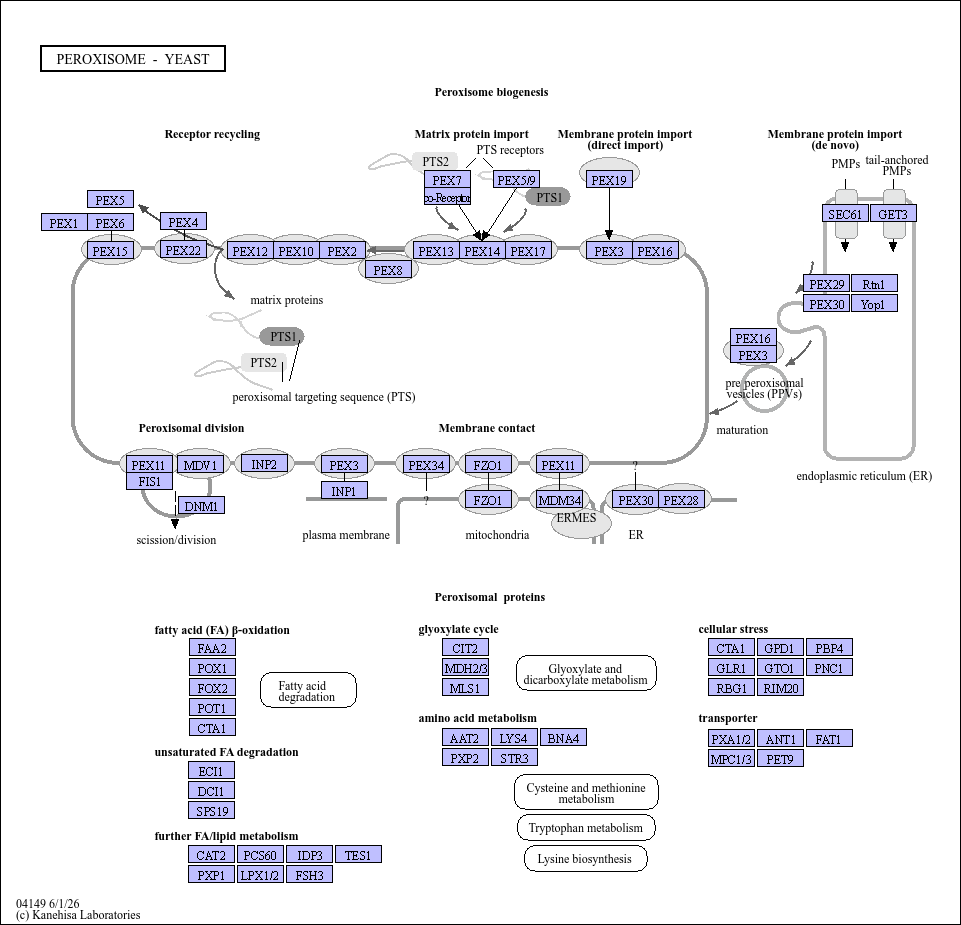
Peroxisomes are dynamic organelles essential for fatty acid beta-oxidation and hydrogen peroxide detoxification. Biogenesis occurs via two co-existing pathways. In growth and division, pre-existing peroxisomes import PMPs post-translationally from the cytosol, mainly via the Pex19-Pex3 system (direct pathway). Matrix proteins are imported via PTS1 (receptor Pex5) or PTS2 (Pex7 with co-receptor). Receptors recycle via mono-ubiquitination and the AAA ATPases Pex1/Pex6. Peroxisome elongation and fission are driven by the Pex11 family proteins, Fis1, and Dnm1. In de novo biogenesis (when peroxisomes are absent), certain PMPs insert into the ER (via Sec61 or GET pathway), sort to pre-peroxisomal ER domains, and bud as pre-peroxisomal vesicles (ppVs). Distinct ppV populations fuse to form import-competent peroxisomes. The Pex30 family proteins help regulate ER shaping and ppV formation. Pex11 and Pex30 family proteins also mediate peroxisome-organelle membrane contact sites. The system is highly flexible, allowing rapid adaptation to metabolic needs.
 Peroxisome - yeast