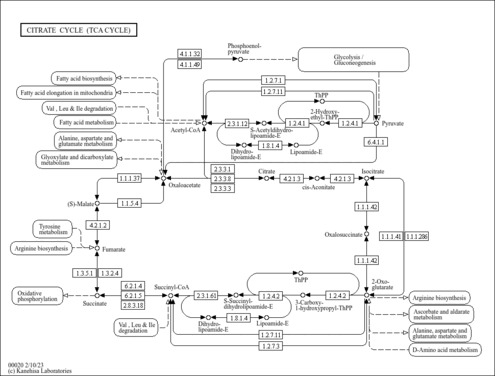
KEGG   PATHWAY: cpat00020
Entry
cpat00020                   Pathway                                
Name
Citrate cycle (TCA cycle) - Clostridium pasteurianum DSM 525 = ATCC 6013
Description
The citrate cycle (TCA cycle, Krebs cycle) is an important aerobic pathway for the final steps of the oxidation of carbohydrates and fatty acids. The cycle starts with acetyl-CoA, the activated form of acetate, derived from glycolysis and pyruvate oxidation for carbohydrates and from beta oxidation of fatty acids. The two-carbon acetyl group in acetyl-CoA is transferred to the four-carbon compound of oxaloacetate to form the six-carbon compound of citrate. In a series of reactions two carbons in citrate are oxidized to CO2 and the reaction pathway supplies NADH for use in the oxidative phosphorylation and other metabolic processes. The pathway also supplies important precursor metabolites including 2-oxoglutarate. At the end of the cycle the remaining four-carbon part is transformed back to oxaloacetate. According to the genome sequence data, many organisms seem to lack genes for the full cycle [MD:M00009], but contain genes for specific segments [MD:M00010 M00011].
Class
Metabolism; Carbohydrate metabolism
Pathway map
cpat00020  Citrate cycle (TCA cycle)
cpat00020

Module
cpat_M00307  Pyruvate oxidation, pyruvate => acetyl-CoA [PATH:cpat00020]
Other DBs
GO: 0006099
Organism
Clostridium pasteurianum DSM 525 = ATCC 6013 [GN:cpat]
Gene
CLPA_c05140  nifJ1; pyruvate-flavodoxin oxidoreductase [KO:K03737] [EC:1.2.7.1 1.2.7.-]
CLPA_c14670  leuA2; 2-isopropylmalate synthase 2 [KO:K05942] [EC:2.3.3.3]
CLPA_c14680  leuB1; 3-isopropylmalate dehydrogenase [KO:K00030] [EC:1.1.1.41]
CLPA_c17490  nifJ2; pyruvate-flavodoxin oxidoreductase [KO:K03737] [EC:1.2.7.1 1.2.7.-]
CLPA_c17500  nifJ3; pyruvate-flavodoxin oxidoreductase [KO:K03737] [EC:1.2.7.1 1.2.7.-]
CLPA_c19670  pdhC; dihydrolipoyllysine-residue acetyltransferase component of pyruvate dehydrogenase complex [KO:K00627] [EC:2.3.1.12]
CLPA_c19680  lpd; dihydrolipoyl dehydrogenase [KO:K00382] [EC:1.8.1.4]
CLPA_c35860  pyc; pyruvate carboxylase [KO:K01958] [EC:6.4.1.1]
CLPA_c36340  fumB; fumarate hydratase class I, anaerobic [KO:K01678] [EC:4.2.1.2]
CLPA_c36350  [KO:K01677] [EC:4.2.1.2]
Compound
C00022  Pyruvate
C00024  Acetyl-CoA
C00026  2-Oxoglutarate
C00036  Oxaloacetate
C00042  Succinate
C00068  Thiamin diphosphate
C00074  Phosphoenolpyruvate
C00091  Succinyl-CoA
C00122  Fumarate
C00149  (S)-Malate
C00158  Citrate
C00311  Isocitrate
C00417  cis-Aconitate
C05125  2-(alpha-Hydroxyethyl)thiamine diphosphate
C05379  Oxalosuccinate
C05381  3-Carboxy-1-hydroxypropyl-ThPP
C15972  Enzyme N6-(lipoyl)lysine
C15973  Enzyme N6-(dihydrolipoyl)lysine
C16254  [Dihydrolipoyllysine-residue succinyltransferase] S-succinyldihydrolipoyllysine
C16255  [Dihydrolipoyllysine-residue acetyltransferase] S-acetyldihydrolipoyllysine
Reference
  Authors
Nishizuka Y (ed).
  Title
[Metabolic Maps] (In Japanese)
  Journal
Tokyo Kagaku Dojin (1980)
Reference
  Authors
Nishizuka Y, Seyama Y, Ikai A, Ishimura Y, Kawaguchi A (eds).
  Title
[Cellular Functions and Metabolic Maps] (In Japanese)
  Journal
Tokyo Kagaku Dojin (1997)
Reference
  Authors
Michal G.
  Title
Biochemical Pathways
  Journal
Wiley (1999)
Related
pathway
cpat00010  Glycolysis / Gluconeogenesis
cpat00053  Ascorbate and aldarate metabolism
cpat00061  Fatty acid biosynthesis
cpat00071  Fatty acid degradation
cpat00190  Oxidative phosphorylation
cpat00220  Arginine biosynthesis
cpat00250  Alanine, aspartate and glutamate metabolism
cpat00280  Valine, leucine and isoleucine degradation
cpat00350  Tyrosine metabolism
cpat00470  D-Amino acid metabolism
cpat00630  Glyoxylate and dicarboxylate metabolism
KO pathway
ko00020   

DBGET integrated database retrieval system