KEGG   PATHWAY: pleu04742
Entry
pleu04742                   Pathway                                
Name
Taste transduction - Peromyscus leucopus (white-footed mouse)
Description
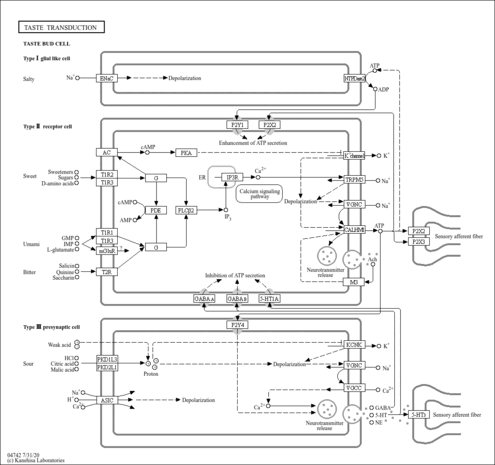
Five basic tastes are recognized by humans and most other animals - bitter, sweet, sour, salty and umami. In vertebrates, taste stimuli are detected by taste receptor cells (TRCs). At least three distinct cell types are found in mammalian taste buds : type I cells, type II cells, and type III cells. Type I cells express epithelial sodium channel (ENaC) and are considered to be the major mediator of perception of low salt. In type II cells, transduction of bitter, sweet and umami is mediated by a canonical PLC-beta/IP3-signaling cascade, which culminates in the opening of the TRPM5 ion channel. This produces a depolarization that may allow CALMH1 channels to open and release ATP, which serves as a neurotransmitter to activate closely associated nerve afferents expressing P2X2, P2X3 receptors and adjacent type III cells expressing P2Y4 receptors. Type II taste cells also secrete acetylcholine (ACh) that appears to stimulate muscarinic receptors, specifically M3, on the same or neighboring Type II cells. This muscarinic feedback augments taste-evoked release of ATP. In type III cells, sour taste is initiated when protons enter through apically located proton-selective ion channels: polycystic kidney disease 2-like 1 protein (PKD2L1) and polycystic kidney disease 1-like 3 protein (PKD1L3) channels. Weak acids may also activate sour cells by penetrating the cell membrane and leading to closure of resting K+ channels and membrane depolarization. Further, voltage-gated Ca2+ channels are activated and release vesicular serotonin (5-HT), norepinephrine (NE) and gamma-aminobutyric acid (GABA). 5-HT and GABA provide negative paracrine feedback onto receptor cells by activating 5-HT1A and GABAA, GABAB receptors, respectively. 5-HT also functions as a transmitter between presynaptic cells and the sensory afferent.
Class
Organismal Systems; Sensory system
Pathway map
pleu04742  Taste transduction
pleu04742

Other DBs
GO: 0050909
Organism
Peromyscus leucopus (white-footed mouse) [GN:pleu]
Gene
114680674  Plcb3; LOW QUALITY PROTEIN: 1-phosphatidylinositol 4,5-bisphosphate phosphodiesterase beta-3 [KO:K05858] [EC:3.1.4.11]
114681254  Gng13; guanine nucleotide-binding protein G(I)/G(S)/G(O) subunit gamma-13 [KO:K04547]
114682700  Gabbr1; gamma-aminobutyric acid type B receptor subunit 1 isoform X1 [KO:K04615]
114682911  P2rx2; P2X purinoceptor 2 isoform X2 [KO:K05216]
114684152  Prkaca; cAMP-dependent protein kinase catalytic subunit alpha isoform X1 [KO:K04345] [EC:2.7.11.11]
114684157  Cacna1a; voltage-dependent P/Q-type calcium channel subunit alpha-1A [KO:K04344]
114684376  [KO:K08474]
114684378  [KO:K08474]
114684386  [KO:K08474]
114684388  [KO:K08474]
114684449  Tas2r38; LOW QUALITY PROTEIN: taste receptor type 2 member 38 [KO:K08474]
114684456  Tas2r3; taste receptor type 2 member 3 [KO:K08474]
114684460  Tas2r4; taste receptor type 2 member 4 [KO:K08474]
114685023  Chrm3; muscarinic acetylcholine receptor M3 isoform X1 [KO:K04131]
114685858  [KO:K08474]
114685859  [KO:K08474]
114685862  [KO:K08474]
114685865  [KO:K08474]
114685870  [KO:K08474]
114686464  Grm1; metabotropic glutamate receptor 1 isoform X1 [KO:K04603]
114687010  Gabra4; gamma-aminobutyric acid receptor subunit alpha-4 isoform X1 [KO:K05175]
114687433  Gabra3; gamma-aminobutyric acid receptor subunit alpha-3 [KO:K05175]
114687634  Gabra2; gamma-aminobutyric acid receptor subunit alpha-2 isoform X1 [KO:K05175]
114688058  [KO:K08474]
114688059  [KO:K08474]
114688060  [KO:K08474]
114688062  [KO:K08474]
114688063  [KO:K08474]
114688064  [KO:K08474]
114689074  [KO:K08474]
114689696  Pde1c; calcium/calmodulin-dependent 3',5'-cyclic nucleotide phosphodiesterase 1C isoform X1 [KO:K13755] [EC:3.1.4.17]
114689843  Gabra6; gamma-aminobutyric acid receptor subunit alpha-6 isoform X1 [KO:K05175]
114689844  Gabra1; gamma-aminobutyric acid receptor subunit alpha-1 isoform X1 [KO:K05175]
114690232  Htr3a; 5-hydroxytryptamine receptor 3A isoform X1 [KO:K04819]
114690361  Htr3b; 5-hydroxytryptamine receptor 3B [KO:K04819]
114691571  Asic2; acid-sensing ion channel 2 isoform X1 [KO:K04828]
114691594  Scn9a; sodium channel protein type 9 subunit alpha [KO:K04841]
114692191  Scnn1g; amiloride-sensitive sodium channel subunit gamma [KO:K04827]
114692194  Scnn1b; amiloride-sensitive sodium channel subunit beta [KO:K04825]
114692785  Entpd2; ectonucleoside triphosphate diphosphohydrolase 2 isoform X1 [KO:K01509] [EC:3.6.1.-]
114694158  Trpm5; transient receptor potential cation channel subfamily M member 5 [KO:K04980]
114694744  [KO:K08474]
114695619  Tas2r16; taste receptor type 2 member 16 [KO:K08474]
114696597  Pde1b; calcium/calmodulin-dependent 3',5'-cyclic nucleotide phosphodiesterase 1B isoform X1 [KO:K13755] [EC:3.1.4.17]
114696709  Calhm1; calcium homeostasis modulator protein 1 [KO:K19738]
114697218  Htr1d; 5-hydroxytryptamine receptor 1D [KO:K04153]
114697724  Adcy8; adenylate cyclase type 8 isoform X1 [KO:K08048] [EC:4.6.1.1]
114697969  Tas2r60; taste receptor type 2 member 60 [KO:K08474]
114697995  Tas2r41; taste receptor type 2 member 41 [KO:K08474]
114697996  [KO:K08474]
114697998  Tas2r40; taste receptor type 2 member 40 [KO:K08474]
114697999  [KO:K08474]
114698264  Prkacb; cAMP-dependent protein kinase catalytic subunit beta isoform X1 [KO:K04345] [EC:2.7.11.11]
114700189  Kcnk5; potassium channel subfamily K member 5 [KO:K04916]
114700261  Htr1b; 5-hydroxytryptamine receptor 1B [KO:K04153]
114700762  Cacna1c; voltage-dependent L-type calcium channel subunit alpha-1C isoform X8 [KO:K04850]
114700900  Tas1r2; LOW QUALITY PROTEIN: taste receptor type 1 member 2 [KO:K04625]
114701832  Tas2r1; taste receptor type 2 member 1 [KO:K08474]
114702349  Gabbr2; LOW QUALITY PROTEIN: gamma-aminobutyric acid type B receptor subunit 2 [KO:K04615]
114702622  Tas1r1; taste receptor type 1 member 1 [KO:K04624]
114703187  P2ry4; P2Y purinoceptor 4 [KO:K04271]
114703320  Htr1a; 5-hydroxytryptamine receptor 1A [KO:K04153]
114703666  Plcb4; 1-phosphatidylinositol 4,5-bisphosphate phosphodiesterase beta-4 isoform X2 [KO:K05858] [EC:3.1.4.11]
114703672  Plcb1; 1-phosphatidylinositol 4,5-bisphosphate phosphodiesterase beta-1 isoform X1 [KO:K05858] [EC:3.1.4.11]
114703726  Pde1a; calcium/calmodulin-dependent 3',5'-cyclic nucleotide phosphodiesterase 1A isoform X1 [KO:K13755] [EC:3.1.4.17]
114704662  [KO:K08474]
114704757  [KO:K04834]
114705921  Plcb2; 1-phosphatidylinositol 4,5-bisphosphate phosphodiesterase beta-2 [KO:K05858] [EC:3.1.4.11]
114706110  Grm4; metabotropic glutamate receptor 4 [KO:K04607]
114706123  Itpr3; inositol 1,4,5-trisphosphate receptor type 3 [KO:K04960]
114706442  Pkd2l1; polycystic kidney disease 2-like 1 protein [KO:K04990]
114707768  P2ry1; P2Y purinoceptor 1 [KO:K04270]
114707791  Scn3a; sodium channel protein type 3 subunit alpha isoform X7 [KO:K04836]
114708053  Pkd1l3; LOW QUALITY PROTEIN: polycystic kidney disease protein 1-like 3 [KO:K04989]
114708226  Gnat3; guanine nucleotide-binding protein G(t) subunit alpha-3 [KO:K19729]
114708261  Tas1r3; taste receptor type 1 member 3 [KO:K04626]
114708522  Adcy6; adenylate cyclase type 6 isoform X1 [KO:K08046] [EC:4.6.1.1]
114708701  Adcy4; adenylate cyclase type 4 [KO:K08044] [EC:4.6.1.1]
114708817  Scnn1a; amiloride-sensitive sodium channel subunit alpha [KO:K04824]
114708827  Gnb3; guanine nucleotide-binding protein G(I)/G(S)/G(T) subunit beta-3 isoform X1 [KO:K07825]
114708928  Hcn4; potassium/sodium hyperpolarization-activated cyclic nucleotide-gated channel 4 [KO:K04957]
114709053  Htr1f; 5-hydroxytryptamine receptor 1F [KO:K04153]
114710135  P2rx3; P2X purinoceptor 3 [KO:K05217]
114710335  [KO:K08474]
114710342  [KO:K08474]
114710343  [KO:K08474]
114710344  [KO:K08474]
114710345  [KO:K08474]
114710346  [KO:K08474]
114710348  [KO:K08474]
114710349  [KO:K08474]
114710481  [KO:K08474]
114710495  Gabra5; gamma-aminobutyric acid receptor subunit alpha-5 [KO:K05175]
Compound
C00002  ATP
C00008  ADP
C00020  AMP
C00025  L-Glutamate
C00031  D-Glucose
C00076  Calcium cation
C00080  H+
C00089  Sucrose
C00095  D-Fructose
C00130  IMP
C00133  D-Alanine
C00144  GMP
C00149  (S)-Malate
C00158  Citrate
C00208  Maltose
C00238  Potassium cation
C00334  4-Aminobutanoate
C00547  L-Noradrenaline
C00575  3',5'-Cyclic AMP
C00740  D-Serine
C00780  Serotonin
C01245  D-myo-Inositol 1,4,5-trisphosphate
C01327  Hydrochloric acid
C01330  Sodium cation
C01451  Salicin
C01996  Acetylcholine
C02265  D-Phenylalanine
C06526  Quinine
C11045  Aspartame
C12283  Saccharin
C12284  Saccharin sodium anhydrous
C19378  Cyclamate
D08836  Acesulfame potassium (NF)
Reference
  Authors
Liman ER, Zhang YV, Montell C
  Title
Peripheral coding of taste.
  Journal
Neuron 81:984-1000 (2014)
DOI:10.1016/j.neuron.2014.02.022
Reference
  Authors
Kinnamon SC, Finger TE
  Title
A taste for ATP: neurotransmission in taste buds.
  Journal
Front Cell Neurosci 7:264 (2013)
DOI:10.3389/fncel.2013.00264
Reference
  Authors
Roper SD
  Title
Taste buds as peripheral chemosensory processors.
  Journal
Semin Cell Dev Biol 24:71-9 (2013)
DOI:10.1016/j.semcdb.2012.12.002
Reference
  Authors
Kinnamon SC
  Title
Taste receptor signalling - from tongues to lungs.
  Journal
Acta Physiol (Oxf) 204:158-68 (2012)
DOI:10.1111/j.1748-1716.2011.02308.x
Reference
  Authors
Kinnamon SC
  Title
Neurosensory transmission without a synapse: new perspectives on taste signaling.
  Journal
BMC Biol 11:42 (2013)
DOI:10.1186/1741-7007-11-42
Reference
  Authors
Chaudhari N, Roper SD
  Title
The cell biology of taste.
  Journal
J Cell Biol 190:285-96 (2010)
DOI:10.1083/jcb.201003144
Reference
  Authors
Vandenbeuch A, Kinnamon SC
  Title
Why do taste cells generate action potentials?
  Journal
J Biol 8:42 (2009)
DOI:10.1186/jbiol138
Reference
  Authors
Chandrashekar J, Hoon MA, Ryba NJ, Zuker CS
  Title
The receptors and cells for mammalian taste.
  Journal
Nature 444:288-94 (2006)
DOI:10.1038/nature05401
Reference
  Authors
Vandenbeuch A, Anderson CB, Parnes J, Enjyoji K, Robson SC, Finger TE, Kinnamon SC
  Title
Role of the ectonucleotidase NTPDase2 in taste bud function.
  Journal
Proc Natl Acad Sci U S A 110:14789-94 (2013)
DOI:10.1073/pnas.1309468110
Reference
  Authors
Taruno A, Vingtdeux V, Ohmoto M, Ma Z, Dvoryanchikov G, Li A, Adrien L, Zhao H, Leung S, Abernethy M, Koppel J, Davies P, Civan MM, Chaudhari N, Matsumoto I, Hellekant G, Tordoff MG, Marambaud P, Foskett JK
  Title
CALHM1 ion channel mediates purinergic neurotransmission of sweet, bitter and umami tastes.
  Journal
Nature 495:223-6 (2013)
DOI:10.1038/nature11906
Reference
  Authors
Gao N, Lu M, Echeverri F, Laita B, Kalabat D, Williams ME, Hevezi P, Zlotnik A, Moyer BD
  Title
Voltage-gated sodium channels in taste bud cells.
  Journal
BMC Neurosci 10:20 (2009)
DOI:10.1186/1471-2202-10-20
Reference
  Authors
Zheng W, Hussein S, Yang J, Huang J, Zhang F, Hernandez-Anzaldo S, Fernandez-Patron C, Cao Y, Zeng H, Tang J, Chen XZ
  Title
A novel PKD2L1 C-terminal domain critical for trimerization and channel function.
  Journal
Sci Rep 5:9460 (2015)
DOI:10.1038/srep09460
Reference
  Authors
Shimada S, Ueda T, Ishida Y, Yamamoto T, Ugawa S
  Title
Acid-sensing ion channels in taste buds.
  Journal
Arch Histol Cytol 69:227-31 (2006)
DOI:10.1679/aohc.69.227
Reference
  Authors
Dando R, Roper SD
  Title
Acetylcholine is released from taste cells, enhancing taste signalling.
  Journal
J Physiol 590:3009-17 (2012)
DOI:10.1113/jphysiol.2012.232009
Reference
  Authors
Kaya N, Shen T, Lu SG, Zhao FL, Herness S
  Title
A paracrine signaling role for serotonin in rat taste buds: expression and localization of serotonin receptor subtypes.
  Journal
Am J Physiol Regul Integr Comp Physiol 286:R649-58 (2004)
DOI:10.1152/ajpregu.00572.2003
Related
pathway
pleu04020  Calcium signaling pathway
KO pathway
ko04742   

DBGET integrated database retrieval system