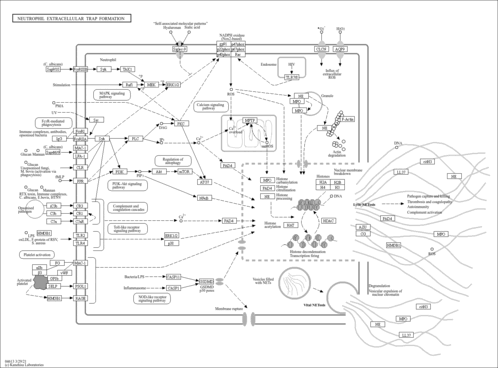
Entry Name Neutrophil extracellular trap formation - Rattus norvegicus (rat)
Description Neutrophils play a central role in innate immune defense. One of the mechanisms of neutrophil action is the formation of neutrophil extracellular traps (NETs), the extracellular structures composed of chromatin coated with histones, proteases and granular and cytosolic proteins that help catch and kill microorganisms. NETs are formed by a process known as "NETosis" that can be triggered by microorganisms and endogenous stimuli, such as damage-associated molecular patterns and immune complexes, and involves activation in most cases of nicotinamide adenine dinucleotide phosphate (NADPH)-oxidase, which produces reactive oxygen species (ROS). Recent study has reported that there are two different mechanisms of NETosis, including a lytic NETosis and a vital NETosis. Lytic NETosis begins with nuclear delobulation and the disassembly of the nuclear envelope and continues with loss of cellular polarization, chromatin decondensation and plasma membrane rupture. Vital NETosis can occur independently of cell death and involves the secreted expulsion of nuclear chromatin that is accompanied by the release of granule proteins through degranulation.
Class Organismal Systems; Immune systemBRITE hierarchy
Pathway map rno04613 Neutrophil extracellular trap formation
Organism Rattus norvegicus (rat) [GN:
rno ]
Gene 113959 C5ar1; C5a anaphylatoxin chemotactic receptor 1 [KO:K04010 ]
116591 Fcgr2a; low affinity immunoglobulin gamma Fc region receptor III isoform 1 [KO:K06463 ]
170911 Pik3ca; phosphatidylinositol 4,5-bisphosphate 3-kinase catalytic subunit alpha isoform [KO:K00922 ] [EC:2.7.1.153 ]
24367 Fgg; fibrinogen gamma chain precursor [KO:K03905 ]
24654 Plcb1; 1-phosphatidylinositol 4,5-bisphosphate phosphodiesterase beta-1 [KO:K05858 ] [EC:3.1.4.11 ]
25031 Plcb4; 1-phosphatidylinositol 4,5-bisphosphate phosphodiesterase beta-4 [KO:K05858 ] [EC:3.1.4.11 ]
25459 Hmgb1; high mobility group protein B1 [KO:K10802 ]
25513 Pik3r1; phosphatidylinositol 3-kinase regulatory subunit alpha [KO:K02649 ]
25738 Plcg1; 1-phosphatidylinositol 4,5-bisphosphate phosphodiesterase gamma-1 [KO:K01116 ] [EC:3.1.4.11 ]
25749 Clcn5; H(+)/Cl(-) exchange transporter 5 isoform 2 [KO:K05012 ]
282819 Ppif; peptidyl-prolyl cis-trans isomerase F, mitochondrial precursor [KO:K09565 ] [EC:5.2.1.8 ]
291157 Hist1h2bo; histone cluster 1 H2B family member O [KO:K11252 ]
292419 Fpr2l1; formyl peptide receptor, related sequence 3 [KO:K04173 ]
29322 Plcb3; 1-phosphatidylinositol 4,5-bisphosphate phosphodiesterase beta-3 [KO:K05858 ] [EC:3.1.4.11 ]
29337 Plcg2; 1-phosphatidylinositol 4,5-bisphosphate phosphodiesterase gamma-2 [KO:K05859 ] [EC:3.1.4.11 ]
29512 Padi4; protein-arginine deiminase type-4 [KO:K24669 ]
295274 Hist2h2be; histone cluster 2 H2B family member E [KO:K11252 ]
295279 Fcgr1a; high affinity immunoglobulin gamma Fc receptor I precursor [KO:K06498 ]
29741 Pik3r2; phosphatidylinositol 3-kinase regulatory subunit beta [KO:K02649 ]
304966 Fcgr3a; low affinity immunoglobulin gamma Fc region receptor III-A precursor [KO:K06463 ]
306945 Hist1h2bq; histone cluster 1 H2B family member Q [KO:K11252 ]
306962 Hist1h2ac; histone cluster 1 H2A family member C [KO:K11251 ]
306969 H2bc8; histone cluster 1 H2B family member l [KO:K11252 ]
310678 Hist2h3c2; histone cluster 2 H3 family member C2 [KO:K11253 ]
312647 Atg7; ubiquitin-like modifier-activating enzyme ATG7 [KO:K08337 ]
316010 Camp; cathelicidin antimicrobial peptide precursor [KO:K13916 ]
361247 Hist1h2bd; histone cluster 1 H2B family member D [KO:K11252 ]
361969 Fga; fibrinogen alpha chain isoform 1 precursor [KO:K03903 ]
363875 Rac1; ras-related C3 botulinum toxin substrate 1 [KO:K04392 ]
363930 Selplg; P-selectin glycoprotein ligand 1 precursor [KO:K06544 ]
366508 Pik3cd; phosphatidylinositol 4,5-bisphosphate 3-kinase catalytic subunit delta isoform [KO:K00922 ] [EC:2.7.1.153 ]
366957 Rac2; ras-related C3 botulinum toxin substrate 2 [KO:K07860 ]
497907 Hmgb1l5; high mobility group protein B1-like [KO:K10802 ]
498885 Slc25a6; solute carrier family 25 member 6 [KO:K05863 ]
502129 hist1h2ail2; histone cluster 1, H2ai-like2 [KO:K11251 ]
502902 Clec7a; C-type lectin domain family 7 member A [KO:K10074 ]
54243 Cr1l; complement component receptor 1-like protein isoform 2 precursor [KO:K04011 ]
58960 Map2k2; dual specificity mitogen-activated protein kinase kinase 2 [KO:K04369 ] [EC:2.7.12.2 ]
60586 Clcn4; H(+)/Cl(-) exchange transporter 4 [KO:K05012 ]
60664 Pik3r3; phosphatidylinositol 3-kinase regulatory subunit gamma [KO:K02649 ]
66021 Cybb; cytochrome b-245 beta chain [KO:K21421 ] [EC:1.-.-.-]
690158 Fpr2; formyl peptide receptor, related sequence 2 [KO:K04173 ]
690198 Fpr2l2; formyl peptide receptor-related sequence 4 [KO:K04173 ]
690230 Fpr2l3; formyl peptide receptor-related sequence 7 [KO:K04173 ]
690521 Hmgb1l3; high mobility group protein B1-like [KO:K10802 ]
691992 Gp1ba; platelet glycoprotein Ib alpha chain precursor [KO:K06261 ]
81722 Ager; advanced glycosylation end product-specific receptor precursor [KO:K19722 ]
81736 Nfkb1; nuclear factor NF-kappa-B p105 subunit isoform 2 [KO:K02580 ]
83529 Vdac1; voltage-dependent anion-selective channel protein 1 [KO:K05862 ]
83531 Vdac2; voltage-dependent anion-selective channel protein 2 [KO:K15040 ]
83532 Vdac3; voltage-dependent anion-selective channel protein 3 [KO:K15041 ]
84360 Clcn3; H(+)/Cl(-) exchange transporter 3 isoform 1 [KO:K05012 ]
85240 Plcb2; 1-phosphatidylinositol 4,5-bisphosphate phosphodiesterase beta-2 [KO:K05858 ] [EC:3.1.4.11 ]
85243 Pik3cb; phosphatidylinositol 4,5-bisphosphate 3-kinase catalytic subunit beta isoform [KO:K00922 ] [EC:2.7.1.153 ]
Compound C01245 D-myo-Inositol 1,4,5-trisphosphate
C05151 12-O-Tetradecanoylphorbol 13-acetate
C05981 Phosphatidylinositol-3,4,5-trisphosphate
C11221 Formylmethionyl-leucyl-phenylalanine methyl ester
Reference Authors Van Avondt K, Hartl D
Title Mechanisms and disease relevance of neutrophil extracellular trap formation.
Journal Reference Authors Sorvillo N, Cherpokova D, Martinod K, Wagner DD
Title Extracellular DNA NET-Works With Dire Consequences for Health.
Journal Reference Authors Papayannopoulos V
Title Neutrophil extracellular traps in immunity and disease.
Journal Reference Authors Liu FC, Chuang YH, Tsai YF, Yu HP
Title Role of neutrophil extracellular traps following injury.
Journal Reference Authors Yang H, Biermann MH, Brauner JM, Liu Y, Zhao Y, Herrmann M
Title New Insights into Neutrophil Extracellular Traps: Mechanisms of Formation and Role in Inflammation.
Journal Reference Authors Zawrotniak M, Bochenska O, Karkowska-Kuleta J, Seweryn-Ozog K, Aoki W, Ueda M, Kozik A, Rapala-Kozik M
Title Aspartic Proteases and Major Cell Wall Components in Candida albicans Trigger the Release of Neutrophil Extracellular Traps.
Journal Reference Authors Honda M, Kubes P
Title Neutrophils and neutrophil extracellular traps in the liver and gastrointestinal system.
Journal Reference Authors Hamam HJ, Palaniyar N
Title Post-Translational Modifications in NETosis and NETs-Mediated Diseases.
Journal Reference Authors Burgener SS, Schroder K
Title Neutrophil Extracellular Traps in Host Defense.
Journal Reference Authors Vorobjeva NV, Chernyak BV
Title NETosis: Molecular Mechanisms, Role in Physiology and Pathology.
Journal Reference Authors Ravindran M, Khan MA, Palaniyar N
Title Neutrophil Extracellular Trap Formation: Physiology, Pathology, and Pharmacology.
Journal Reference Authors Jorch SK, Kubes P
Title An emerging role for neutrophil extracellular traps in noninfectious disease.
Journal Reference Authors Goggs R, Jeffery U, LeVine DN, Li RHL
Title Neutrophil-Extracellular Traps, Cell-Free DNA, and Immunothrombosis in Companion Animals: A Review.
Journal Reference Authors Kim SJ, Jenne CN
Title Role of platelets in neutrophil extracellular trap (NET) production and tissue injury.
Journal Reference Authors de Bont CM, Boelens WC, Pruijn GJM
Title NETosis, complement, and coagulation: a triangular relationship.
Journal Reference Authors Zawrotniak M, Bartnicka D, Rapala-Kozik M
Title UVA and UVB radiation induce the formation of neutrophil extracellular traps by human polymorphonuclear cells.
Journal Reference Authors Remijsen Q, Kuijpers TW, Wirawan E, Lippens S, Vandenabeele P, Vanden Berghe T
Title Dying for a cause: NETosis, mechanisms behind an antimicrobial cell death modality.
Journal Reference Authors Zawrotniak M, Rapala-Kozik M
Title Neutrophil extracellular traps (NETs) - formation and implications.
Journal Acta Biochim Pol 60:277-84 (2013)
Reference Authors Rosales C
Title Fcgamma Receptor Heterogeneity in Leukocyte Functional Responses.
Journal Reference Authors Vorobjeva NV, Pinegin BV
Title Neutrophil extracellular traps: mechanisms of formation and role in health and disease.
Journal Reference Authors Delgado-Rizo V, Martinez-Guzman MA, Iniguez-Gutierrez L, Garcia-Orozco A, Alvarado-Navarro A, Fafutis-Morris M
Title Neutrophil Extracellular Traps and Its Implications in Inflammation: An Overview.
Journal Reference Authors Fonseca Z, Diaz-Godinez C, Mora N, Aleman OR, Uribe-Querol E, Carrero JC, Rosales C
Title Entamoeba histolytica Induce Signaling via Raf/MEK/ERK for Neutrophil Extracellular Trap (NET) Formation.
Journal Reference Authors Agraz-Cibrian JM, Giraldo DM, Mary FM, Urcuqui-Inchima S
Title Understanding the molecular mechanisms of NETs and their role in antiviral innate immunity.
Journal Reference Authors Schonrich G, Raftery MJ
Title Neutrophil Extracellular Traps Go Viral.
Journal Reference Authors Saitoh T, Komano J, Saitoh Y, Misawa T, Takahama M, Kozaki T, Uehata T, Iwasaki H, Omori H, Yamaoka S, Yamamoto N, Akira S
Title Neutrophil extracellular traps mediate a host defense response to human immunodeficiency virus-1.
Journal Reference Authors Kumar S, Gupta E, Kaushik S, Jyoti A
Title Neutrophil Extracellular Traps: Formation and Involvement in Disease Progression.
Journal Iran J Allergy Asthma Immunol 17:208-220 (2018)
Related rno04610 Complement and coagulation cascades
rno04620 Toll-like receptor signaling pathway
rno04621 NOD-like receptor signaling pathway
rno04666 Fc gamma R-mediated phagocytosis
KO pathway